| Chemical Properties |
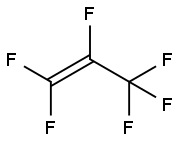
Hexafluoropropylene (HFP) is a colourless, odourless, non-flammable gas that is only slightly soluble in water. It is used as chemical intermediate primarily in the synthesis of fluoropolymers, fluoro-elastomers and fluorinated materials (e.g. perfluoropolyether functional fluids, oils and greases). |
| Uses |
Hexafluoropropene is used in the synthesis of polyvinylidene fluoride-co-hexafluoropropylene, a polymer which is currently being used in various fields of the nano and electronic sector ranging from membranes to nanoparticles. |
| Preparation |
Hexafluoropropylene can be produced by pyrolysis of tetrafluoroethylene (TFE):
3 CF2=CF2 → 2 CF3CF=CF
This reaction is carried out in a closed continuous reactor at 600 to 900°C. The yield can be improved at low partial pressure, achieved either by operating under reduced total pressure (down to 0.1 bar) or by injecting an inert diluent such as steam or CO2.
Significant quantities of by-products, including the highly toxic perfluoroisobutylene (PFIB), are formed during the pyrolysis of TFE. Such by-products are either incinerated directly or are collected and transported for incineration at a remote facility.
Hexafluoropropylene can also be prepared from chlorodifluoromethane, or produced from various chlorofluorocarbons. |
| Synthesis Reference(s) |
Journal of the American Chemical Society, 73, p. 4054, 1951 DOI: 10.1021/ja01152a548 |
| General Description |
Hexafluoropropylene is an odorless, colorless gas. Hexafluoropropylene is noncombustible. Hexafluoropropylene can asphyxiate by the displacement of air. Exposure of the container to prolonged heat or fire can cause Hexafluoropropylene to rupture violently and rocket. |
| Reactivity Profile |
Halogenated aliphatic compounds, such as Hexafluoropropylene, are moderately or very reactive. Reactivity generally decreases with increased degree of substitution of halogen for hydrogen atoms. Materials in this group may be incompatible with strong oxidizing and reducing agents. Also, they may be incompatible with many amines, nitrides, azo/diazo compounds, alkali metals, and epoxides. Above a minimum oxygen pressure, the reaction of oxygen difluoride and hexafluoropropene to yield the Hexafluoropropylene oxide becomes explosive, Chem. Abs., 1987, 107, 175302. The reaction of hexafluoropropene with grignard reagent (subst. phenylmagnesium bromides) led to explosion, Fluorine Chem., 1981, 18, 25. |
| Health Hazard |
Vapors may cause dizziness or asphyxiation without warning. Vapors from liquefied gas are initially heavier than air and spread along ground. Contact with gas or liquefied gas may cause burns, severe injury and/or frostbite. Fire may produce irritating, corrosive and/or toxic gases. |
| Fire Hazard |
Some may burn but none ignite readily. Containers may explode when heated. Ruptured cylinders may rocket. |
| Flammability and Explosibility |
Non flammable |