| Description |
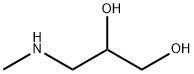
3-Methylamino-1,2-propanediol (MAPD) is a clear liquid with the chemical formula C4H11NO2. It can be synthesized from allylamine and alkanolamine via a thermal process. It reacts with chloride to form methyl chloroacetate, which can then be converted into 3-methylamino-1,2-propanediol by reaction with methanol. The production process for this substance has been shown to generate low levels of hazardous substances such as polycyclic aromatic hydrocarbons (PAHs) and dioxins. |
| Chemical Properties |
clear colorless to pale yellow viscous liquid |
| Uses |
3-Methylamino-1,2-propanediol is a reactive compound that is used in the synthesis of organic acids. It is also used as an intermediate in the manufacture of polyethylene glycols and particle coatings. |
| Definition |
ChEBI: 3-methylamino-1,2-propanediol is a secondary amine. |
| Preparation |
3-Methylamino-1,2-propanediol (MAPD) is synthesized by reacting 3-chloro-1,2-propanediol (CPD) with monomethyl amine in alkaline environment by adding sodium hydroxide. Afterwards, the product undergoes a series of purification steps.

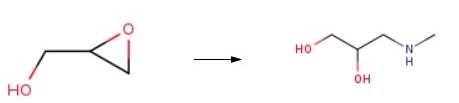
N-Methyl-1-amino-2,3-propandiol (45A) Methylamine (172ml of a 40% solution in water, 2 mol) was cooled to 0 °C and 2,3-epoxy-1-propanol (25g, 0.34mol) was added at a rate to maintain the temperature at or below 10 °C. The mixture was stirred for 3 hours at 0 °C. Excess methylamine and water was evaporated in vacuo and the product was purified by distillation at 103-105 °C, at 0.5 mm Hg, to give the compound 3-Methylamino-1,2-propanediol.
 |
| Hazard |
3-Methylamino-1,2-propanediol is danger.
H314 (32.76%): Causes severe skin burns and eye damage [Danger Skin corrosion/irritation]
H315 (67.24%): Causes skin irritation [Warning Skin corrosion/irritation]
H319 (65.52%): Causes serious eye irritation [Warning Serious eye damage/eye irritation]
H335 (100%): May cause respiratory irritation [Warning Specific target organ toxicity, single exposure; Respiratory tract irritation] |