



Product Introduction
| Hexahydrophthalic anhydride Basic information |
| Description References |
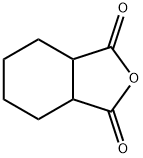
| Product Name: | Hexahydrophthalic anhydride |
| Synonyms: | 1,2-Cyclohexanedicarboxylic Acid anhydride;1,3-Isobenzofurandione, hexahydro-;3-Isobenzofurandione,hexahydro-1;Araldite HT 907;hexahydro-3-isobenzofurandione;Lekutherm Hardener H;NT 907;CALCIUM 2-NAPTHYLPHOSPHATE |
| CAS: | 85-42-7 |
| MF: | C8H10O3 |
| MW: | 154.16 |
| EINECS: | 201-604-9 |
| Product Categories: | Organics;Diels-Alder Adducts |
| Mol File: | 85-42-7.mol |
 |
|
| Hexahydrophthalic anhydride Chemical Properties |
| Melting point | 32-34 °C(lit.) |
| Boiling point | 158 °C17 mm Hg(lit.) |
| density | 1.18 |
| vapor pressure | 0.31Pa at 25℃ |
| refractive index | 1.4620 (estimate) |
| RTECS | NP6895168 |
| Fp | >230 °F |
| storage temp. | Store below +30°C. |
| solubility | Chloroform, Methanol (Slightly) |
| form | Solid |
| pka | 4.14[at 20 ℃] |
| color | White to Off-White |
| Water Solubility | 4.2g/L at 20℃ |
| Sensitive | Moisture Sensitive |
| BRN | 83213 |
| Exposure limits | ACGIH: Ceiling 0.005 mg/m3 |
| Stability: | Moisture Sensitive |
| LogP | -4.14 at 20℃ |
| CAS DataBase Reference | 85-42-7(CAS DataBase Reference) |
| NIST Chemistry Reference | 1,2-Cyclohexane dicarboxylic anhydride(85-42-7) |
| EPA Substance Registry System | Hexahydrophthalic anhydride (85-42-7) |
| Safety Information |
| Hazard Codes | Xn |
| Risk Statements | 41-42/43 |
| Safety Statements | 23-24-26-37/39 |
| RIDADR | 3335 |
| WGK Germany | 1 |
| TSCA | Yes |
| HS Code | 29172090 |
| Hazardous Substances Data | 85-42-7(Hazardous Substances Data) |
| MSDS Information |
| Provider | Language |
|---|---|
| Cyclohexane-1,2-dicarboxylic anhydride | English |
| ALFA | English |
| Hexahydrophthalic anhydride Usage And Synthesis |
| Description | Hexahydrophthalic anhydride (HHPA) is widely used for electronics applications, e.g. HHPA cured epoxy resins have excellent dielectric properties, high-temperature stability, and high glass transition temperatures. HHPA is used as a curing agent in adhesive coatings and sealant materials, e.g. for the second-generation two-part epoxy adhesive synthesis. Hexahydrophthalic anhydride is also used in the manufacture of alkyd and polyester resins, insecticides, and rust preventives. |
| References | [1] Guy Rabilloud, High Performance Polymers. Vol. 1 Conductive Adhesives, 1997 [2] John Burke Sullivan and Gary R. Krieger, Clinical Environmental Health and Toxic Exposures, 2001 [3] B. A. G. Jönsson, H. Welinder, C. Hansson and B. Ståhlbom, Occupational exposure to hexahydrophthalic anhydride: air analysis, percutaneous absorption, and biological monitoring, International Archives of Occupational and Environmental Health 1993, vol. 65, 43-47 |
| Chemical Properties | White crystalline powder |
| Uses | Intermediate for alkyds, plasticizers, insect repellents, and rust inhibitors; hardener in epoxy resins. |
| Uses | HPPA, in combination with triethaylamine (TEA), can be used as a polymerization initiator in the preparation of polyester based resins. It can also be used as a hardener to cure 1,4-butanediol diglycidyl ether which can be used as an epoxy based system for electronic devices. |
| Application | Predominantly cis 1,2-cyclohexanedicarboxylic anhydride (HHPA) is a cyclic anhydride that can be used for a variety of applications such as: plasticizer, rust inhibitor, and a curing agent for epoxy based resins. HPPA, in combination with triethaylamine (TEA), can be used as a polymerization initiator in the preparation of polyester based resins. It can also be used as a hardener to cure 1,4-butanediol diglycidyl ether which can be used as an epoxy based system for electronic devices. |
| Definition | ChEBI: A cyclic dicarboxylic anhydride that is the cyclic anhydride of hexahydrophthalic acid. |
| General Description | Predominantly cis 1,2-cyclohexanedicarboxylic anhydride (HHPA) is a cyclic anhydride that can be used for a variety of applications such as: plasticizer, rust inhibitor, and a curing agent for epoxy based resins. |
| Hazard | Toxic by inhalation, strong irritant to eyes and skin. |
| Flammability and Explosibility | Non flammable |
| Synthesis | Hexahydrophthalic anhydride is obtained by reacting ciscyclohexane-1, 2-dicarboxylic acid with oxalyl chloride.Combine ciscyclohexane-1, 2-dicarboxylic acid (1 mmol, 172 mg) and oxalyl chloride (1.2 mmol, 152 mg, 0.103 ml) in dry toluene (5 mL) and add a drop of freshly distilled DMF. Purge the reaction vessel with argon and heat the reaction under stirring for 3 h. Stop the stirring, decant the toluene solution and filter. Evaporate the volatiles. Transform into crystalline form by trituration with diethyl ether. 1H NMR (400 MHz, CDCl3) |? 3.18 - 3.12 (m, 2H 2CH) 1.96 - 1.83 (m, 4H 2CH2) 1.57 - 1.49 (m, 4H 2CH2). HRMS (ESI), calcd for C8H10NaO3 [M+Na]+ 175.0522, found 175.0527; calcd for C9H14NaO4 [M+CH3 OH+Na]+ 209.0784, found 209.0788.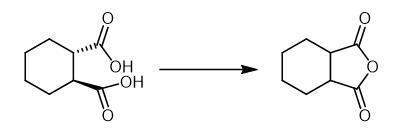 Fig The synthetic method of Hexahydrophthalic anhydride. |
| Purification Methods | It has been obtained by heating the trans-acid or anhydride at 200o. Crystallise it from *C6H6/Et2O or distil it. [Kohler & Jansen J Am Chem Soc 60 2145 1938, Abell J Org Chem 22 769 1957, Beilstein 17 II 452, 17 III/IV 5931.] |
| Raw materials | Tetrachlorophthalic anhydride-->2-Cyclohexene-1,2-dicarboxylic acid-->3,4,5,6-tetrahydrophthalic acid-->cis-Hexahydrophthalic acid-->3,4,5,6-Tetrahydrophthalic anhydride-->1,2,3,6-Tetrahydrophthalic anhydride |
| Preparation Products | 1(3H)-Isobenzofuranone,hexahydro--->1,2-Bis(7-Methyloctyl)cyclohexyl-1,2-dicarboxylate |
Hot Tags: hexahydrophthalic anhydride, China hexahydrophthalic anhydride manufacturers, suppliers, factory, 1 6 Hexamethylene Diacrylate, CAS 2223 82 7, Ethoxylated 3 Trimethylolpropane Triacrylate, CAS 7328 17 8, CAS 42978 66 5, Isobornyl Acrylate
Previous: Methylhexahydrophthalic Anhydride
You Might Also Like


Send Inquiry
