



Product Introduction
| Glycidyl phenyl ether Basic information |
| Product Name: | Glycidyl phenyl ether |
| Synonyms: | GLYCIDYL PHENYL ETHER;2,3-EPOXYPROPYL PHENYL ETHER;Phenyl tlycidyl ether;PHENYL 2,3-EPOXYPROPYL ETHER;PHENYL GLYCID ETHER;PHENYL GLYCIDYL ETHER;PGE;1-PHENOXY-2,3-PROPYLENE OXIDE |
| CAS: | 122-60-1 |
| MF: | C9H10O2 |
| MW: | 150.17 |
| EINECS: | 204-557-2 |
| Product Categories: | Oxiranes;Simple 3-Membered Ring Compounds;K00001 |
| Mol File: | 122-60-1.mol |
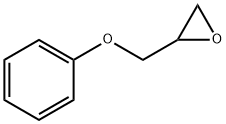 |
|
| Glycidyl phenyl ether Chemical Properties |
| Melting point | 3.5 °C(lit.) |
| Boiling point | 245-247 °C(lit.) |
| density | 1.109 g/mL at 25 °C(lit.) |
| vapor density | 5.2 (vs air) |
| vapor pressure | 0.03 mm Hg ( 20 °C) |
| refractive index | n20/D 1.531 |
| Fp | >230 °F |
| storage temp. | Store below +30°C. |
| solubility | 2.4g/l |
| form | Liquid |
| color | Clear colorless to yellow |
| Water Solubility | 2.4 g/L (20 ºC) |
| BRN | 2744 |
| Exposure limits | TLV-TWA 6 mg/m3 (1 ppm) (ACGIH); 1 ppm (15 min) (NIOSH). |
| Stability: | Stable. Incompatible with strong oxidizing agents. |
| InChIKey | FQYUMYWMJTYZTK-UHFFFAOYSA-N |
| LogP | 1.61 at 25℃ |
| CAS DataBase Reference | 122-60-1(CAS DataBase Reference) |
| NIST Chemistry Reference | Oxirane, (phenoxymethyl)-(122-60-1) |
| IARC | 2B (Vol. 47, 71) 1999 |
| EPA Substance Registry System | Phenyl glycidyl ether (122-60-1) |
| Safety Information |
| Hazard Codes | T |
| Risk Statements | 45-20-37/38-43-52/53-68 |
| Safety Statements | 53-45-61 |
| RIDADR | 2810 |
| WGK Germany | 3 |
| RTECS | TZ3675000 |
| Autoignition Temperature | 430 °C |
| TSCA | Yes |
| HazardClass | IRRITANT |
| HS Code | 29109000 |
| Hazardous Substances Data | 122-60-1(Hazardous Substances Data) |
| Toxicity | LD50 orally in Rabbit: 2150 mg/kg LD50 dermal Rabbit 1500 mg/kg |
| IDLA | 100 ppm |
| MSDS Information |
| Provider | Language |
|---|---|
| 2,3-Epoxypropylphenylether | English |
| SigmaAldrich | English |
| ACROS | English |
| ALFA | English |
| Glycidyl phenyl ether Usage And Synthesis |
| Chemical Properties | Phenyl glycidyl ether, also known as glycidyl phenyl ether or PGE, is a clear liquid with a sweet odor that is considered unpleasant. It is soluble in ether and benzene, but insoluble in water. It has the ability to volatilize with water vapor. It is used in the production of epoxy resins, as a chemical intermediate, and as a stabilizer. |
| Uses | Phenyl glycidyl ether (PGE) is utilized in organic syntheses as an intermediate. As a reactive diluent, PGE is incorporated into uncured epoxy resins to lower viscosity, thereby facilitating casting, adhesives, and laminating applications. |
| Uses | 2-Phenylglycidyl ether is an organic synthesis; chemical intermediate with high solvency for halogenated materials; reactive diluent of epoxy-resin systems; forms chemical bonds with the resin during cure and accelerates the curing process. |
| Production Methods | PGE is synthesized by condensation of phenol with epichlorohydrin, with subsequent dehydrochlorination with caustic to form the epoxy ring. |
| Definition | ChEBI: Phenyl glycidyl ether is an aromatic ether. |
| Synthesis Reference(s) | The Journal of Organic Chemistry, 50, p. 1784, 1985 DOI: 10.1021/jo00210a053 |
| General Description | Colorless liquid. |
| Air & Water Reactions | Ethers tend to form unstable peroxides when exposed to oxygen. Ethyl, isobutyl, ethyl tert-butyl, and ethyl tert-pentyl ether are particularly hazardous in this respect. Ether peroxides can sometimes be observed as clear crystals deposited on containers or along the surface of the liquid. Slightly soluble in water. |
| Reactivity Profile | Glycidyl phenyl ether, an ether, can act as a base. They form salts with strong acids and addition complexes with Lewis acids. The complex between diethyl ether and boron trifluoride is an example. Ethers may react violently with strong oxidizing agents. In other reactions, which typically involve the breaking of the carbon-oxygen bond, ethers are relatively inert. |
| Health Hazard | PGE is a toxic compound exhibiting moderate irritant action and carcinogenicity inanimals. Application of 0.25 mg resulted insevere eye irritation in rabbits, while 500 mgcaused moderate skin irritation over a periodof 24 hours. Prolonged or repeated contactcan cause moderate irritation and skin sensitization in humans. The symptoms of its toxicity in animalswere depression of the central nervous system and paralysis of the respiratory tract.Prolonged exposure caused changes in thekidney, liver, thymus, and testes, and lossof hair in rats. The toxicity of this compound in humans is low and the health hazardcan arise primarily from its skin-sensitizationaction. LD50 value, oral (mice): 1400 mg/kg DGE showed carcinogenicity in rats, causingnasal cancer. |
| Fire Hazard | Glycidyl phenyl ether is probably combustible. |
| Contact allergens | This monoglycidyl derivative is a reactive diluent in epoxy resins Bisphenol A type. It is a component of epoxy paints, epoxy glues, and epoxy resins. Sensitization has been observed in many professions, such as in construction workers, marble workers, ceramic workers, and shoemakers. |
| Safety Profile | Confirmed carcinogen with experimental carcinogenic data. Moderately toxic by ingestion, skin contact, and subcutaneous routes. A severe eye and skin irritant. Experimental reproductive effects. Mutation data reported. When heated to decomposition it emits acrid smoke and irritating fumes. Used as a chemical intermediate. See also ETHERS |
| Potential Exposure | PGE is used to increase storage time and stability of halogenated compounds; as a reactive diluent in uncured epoxy resins to reduce the viscosity of the uncured system for ease in casting; adhesive, and laminating applications. NIOSH once estimated that 8000 workers are potentially exposed to PGE. |
| Carcinogenicity | Chronic exposure of rats to 1 or 12ppm 6 hours/day, 5 days/week for 2 years caused an increased incidence of rhinitis, squamous metaplasia, and epidermal carcinomas of the nasal cavity.4 The IARC has determined that there is sufficient evidence for the carcinogenicity of PGE in animals and that it is possibly carcinogenic to humans. |
| Shipping | UN2810 Toxic liquids, organic, n.o.s., Hazard Class: 6.1; Labels: 6.1-Poisonous materials, Technical Name Required. |
| Incompatibilities | Incompatible with oxidizers (chlorates, nitrates, peroxides, permanganates, perchlorates, chlorine, bromine, fluorine, etc.); contact may cause fires or explosions. Keep away from alkaline materials, strong bases, strong acids, oxoacids, epoxides, amines, and curing agents. PGE can presumably form explosive peroxides |
| Waste Disposal | Concentrated waste containing no peroxides-discharge liquid at a controlled rate near a pilot flame. Concentrated waste containing peroxidesperforation of a container of the waste from a safe distance followed by open burning. |
| Glycidyl phenyl ether Preparation Products And Raw materials |
| Raw materials | Potassium carbonate-->Epichlorohydrin |
| Preparation Products | CORTEX ALDEHYDE 50 BENZYL ALCOHOL-->(S)-2-Oxiranylanisole-->3-Phenoxy-1-propanol-->TRANS-1,2-CYCLOHEXANEDIOL-->CHEMBRDG-BB 5482082 |
Hot Tags: glycidyl phenyl ether, China glycidyl phenyl ether manufacturers, suppliers, factory, 1 6 Hexamethylene Diacrylate, CAS 7328 17 8, CAS 2399 48 6, CAS 32360 05 7, Ethoxylated Bisphenol A Diacrylate, Di-functional
Previous: Butyl Glycidyl Ether
You Might Also Like
-

1,6-Hexanediol Diglycidyl Ether
-
China Manufacturer Supply CAS 108-65-6 Propylene glycol monomethyl ether acetate/PMA
-
CAS 34590-94-8 Dipropylene glycol monomethyl ether/DPM
-
Factory Sell Good Price CAS 3033-62-3 Bis(2-dimethylaminoethyl) ether
-

Hms 232r 239b 244b Allyl Alcohol Polyether CAS 27274-31-3
-

Factory Supply Poly (ethyl vinyl ether) CAS 25104-37-4
Send Inquiry
