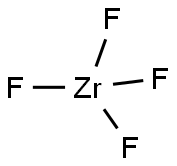
Catalysis and Inorganic Chemistry;Chemical Synthesis;Crystal Grade Inorganics;Materials Science;Metal and Ceramic Science;Zirconium;Catalysis and Inorganic Chemistry;Chemical Synthesis;Crystal Grade Inorganics;Salts;Zirconium Salts;ZirconiumMetal and Ceramic Science;metal halide;Zirconium Salts;Inorganics
Mol File:
7783-64-4.mol
Zirconium fluoride Chemical Properties
Melting point
640 °C
Boiling point
905 °C
density
4,43 g/cm3
refractive index
1.59
solubility
1.388 g/100 mL
form
Powder
Specific Gravity
4.43
color
White
Water Solubility
1.388 g/100 mL
Sensitive
Moisture Sensitive
Merck
14,10175
Exposure limits
ACGIH: TWA 5 mg/m3; TWA 2.5 mg/m3; STEL 10 mg/m3
NIOSH: IDLH 25 mg/m3; IDLH 250 mg/m3; TWA 5 mg/m3; STEL 10 mg/m3
CAS DataBase Reference
7783-64-4(CAS DataBase Reference)
NIST Chemistry Reference
Zirconium tetrafluoride(7783-64-4)
EPA Substance Registry System
Zirconium fluoride (ZrF4), (T-4)- (7783-64-4)
Safety Information
Hazard Codes
C,Xi
Risk Statements
34-36/37/38
Safety Statements
26-27-28-36/37/39-45
RIDADR
UN 3260 8/PG 2
WGK Germany
3
RTECS
ZH7875000
Hazard Note
Corrosive
TSCA
Yes
HazardClass
8
PackingGroup
II
HS Code
28261990
MSDS Information
Provider
Language
Zirconium tetrafluoride
English
SigmaAldrich
English
ACROS
English
ALFA
English
Zirconium fluoride Usage And Synthesis
Chemical Properties
White powder. Slightly soluble in water and hydrogen fluoride.
Uses
Zirconium tetrafluoride is used in some fluoridebased glasses. These glasses are the first chemically and mechanically stable bulk glasses to have continuous high transparency from the near uv to the mid-ir (0.3–6 μm).
Uses
Zirconium fluoride is used as a zirconium source in oxygen-sensitive applications such as metal production.
Uses
Component of molten salts for nuclear reactors.
Hazard
Strong irritant. TLV: 2.5 mg(F)/m3.
Safety Profile
Poison by intravenous route. When heated to decomposition it emits toxic fumes of F-. See also ZIRCONIUM COMPOUNDS and FLUORIDES.
Zirconium fluoride Preparation Products And Raw materials