| Description |
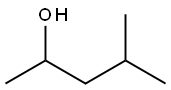
MIBC is a colorless liquid with a mild odor.The odor threshold is 0.52 ppm. Molecularweight 5 102.20; Specific gravity (H2O:1) 5 0.81; Boilingpoint 5 132.8℃; Freezing/Melting point 5 2 90℃; Vaporpressure 5 3 mmHg at 20℃; Flash point = 41℃. Theexplosive limits are LEL 5 1.0%; UEL 5 5.5%. HazardIdentification (based on NFPA-704 M Rating System):Health 2, Flammability 2, Reactivity 0. Slightly soluble inwater; solubility 5 2%. |
| Chemical Properties |
colourless liquid |
| Chemical Properties |
MIBC is a colorless liquid with a mild odor. The odor threshold is 0.52 ppm. |
| Uses |
Solvent for dyestuffs, oils, gums, resins, waxes, nitrocellulose, and ethylcellulose; organic synthesis; froth flotation; brake fluids. |
| Uses |
Solvent; organic syntheses; brake fluids |
| Uses |
(^+)-4-Methyl-2-pentanol is employed as a solvent in organic synthesis, dyes and stains, natural resins and waxes. It is an additive to surface coatings. It finds applications in the manufacture of lube oil additives, zinc dialkyldithiophosphate, brake fluids. It is the precursor to some plasticizers and frother in mineral flotation. It acts as a corrosion inhibitor and also utilized in the characterization of volatile fraction of mono varietal wines and tar sand mining processes. |
| Production Methods |
Methyl isobutyl carbinol is prepared commercially as a byproduct of the synthesis of methyl isobutyl ketone. |
| Synthesis Reference(s) |
Journal of the American Chemical Society, 82, p. 3222, 1960 DOI: 10.1021/ja01497a062
Tetrahedron Letters, 25, p. 5897, 1984 DOI: 10.1016/S0040-4039(01)81714-7 |
| General Description |
A clear colorless liquid. Flash point 120°F. Less dense than water. Vapors heavier than air. |
| Air & Water Reactions |
Flammable. Soluble in water. |
| Reactivity Profile |
4-Methyl-2-pentanol is an alcohol. Flammable and/or toxic gases are generated by the combination of alcohols with alkali metals, nitrides, and strong reducing agents. They react with oxoacids and carboxylic acids to form esters plus water. Oxidizing agents convert them to aldehydes or ketones. Alcohols exhibit both weak acid and weak base behavior. They may initiate the polymerization of isocyanates and epoxides. 4-Methyl-2-pentanol is incompatible with strong oxidizers . |
| Hazard |
Moderate fire risk, explosive limits in air 1– 5.5%. Eye and upper respiratory tract irritant, and central nervous system impairment. |
| Health Hazard |
Vapor irritates eyes and nose; may cause anesthesia. Prolonged contact with liquid causes irritation and cracking of skin; also irritates eyes. |
| Fire Hazard |
HIGHLY FLAMMABLE: Will be easily ignited by heat, sparks or flames. Vapors may form explosive mixtures with air. Vapors may travel to source of ignition and flash back. Most vapors are heavier than air. They will spread along ground and collect in low or confined areas (sewers, basements, tanks). Vapor explosion hazard indoors, outdoors or in sewers. Runoff to sewer may create fire or explosion hazard. Containers may explode when heated. Many liquids are lighter than water. |
| Flammability and Explosibility |
Flammable |
| Chemical Reactivity |
Reactivity with Water: No reaction; Reactivity with Common Materials: No reaction; Stability During Transport: Stable; Neutralizing Agents for Acids and Caustics: Not pertinent; Polymerization: Not pertinent; Inhibitor of Polymerization: Not pertinent. |
| Safety Profile |
Moderately toxic by ingestion, skin contact, and intraperitoneal routes. Mildly toxic by inhalation. A skin and severe eye irritant. Inhalation of high concentrations can cause anesthesia. Flammable liquid when exposed to heat or flame; can react with oxidizing materials. A moderate explosion hazard when exposed to heat or flame. To fight fire, use alcohol foam. When heated to decomposition it emits acrid smoke and fumes. |
| Potential Exposure |
MIBC is used as a solvent; in the formulation of brake fluids; as an intermediate in organic synthesis. |
| First aid |
If this chemical gets into the eyes, remove anycontact lenses at once and irrigate immediately for at least15 min, occasionally lifting upper and lower lids. Seek medical attention immediately. If this chemical contacts theskin, remove contaminated clothing and wash immediatelywith soap and water. Seek medical attention immediately. Ifthis chemical has been inhaled, remove from exposure,begin rescue breathing (using universal precautions, including resuscitation mask) if breathing has stopped and CPR ifheart action has stopped. Transfer promptly to a medicalfacility. When this chemical has been swallowed, get medical attention. Give large quantities of water and inducevomiting. Do not make an unconscious person vomit. |
| storage |
Color Code-Red: Flammability Hazard: Store ina flammable liquid storage area or approved cabinet awayfrom ignition sources and corrosive and reactive materials.Prior to working with this chemical you should be trainedon its proper handling and storage. Before entering confinedspace where this chemical may be present, check to makesure that an explosive concentration does not exist. Methylamyl alcohol must be stored to avoid contact with peroxides, chlorates, perchlorates, permanganates, and nitratessince violent reactions occur. Store in tightly closed containers in a cool, well-ventilated area away from heat.Sources of ignition, such as smoking and open flames, areprohibited where methyl amyl alcohol is used, handled, orstored in a manner that could create a potential fire orexplosion hazard. |
| Shipping |
UN2053Methyl isobutyl carbinol, Hazard Class: 3; Labels: 3-Flammable liquid |
| Purification Methods |
Wash the 2-pentanol with aqueous NaHCO3, dry and distil it. Purify it further by converting it to the phthalate ester by adding 120mL of dry pyridine and 67g of phthalic anhydride per mole of alcohol, purifying the ester and steam distilling it in the presence of NaOH. The distillate is extracted with ether, and the extract is dried and fractionally distilled. [Levine & Walti J Biol Chem 94 367 1931, Beilstein 1 IV 1717.] |
| Incompatibilities |
Vapor may form explosive mixture with air. Incompatible with oxidizers (chlorates, nitrates, peroxides, permanganates, perchlorates, chlorine, bromine, fluorine, etc.); contact may cause fires or explosions. Keep away from alkaline materials, strong acids, peroxysulfuric acid, strong bases, caustics, aliphatic amines; isocyanates. Contact with alkali metals produces hydrogen gas. Permissibl |
| Waste Disposal |
Incineration; other, more flammable solvent may be added. |