


Product Introduction
| Glyoxal Basic information |
| Product Name: | Glyoxal |
| Synonyms: | BISFORMYL;glyoxylaldehyde;GLYOXAL SOLUTION;GLYOXAL;DIFORMYL;ETHANEDIAL;1,2-ethanedione;(CHO)2 |
| CAS: | 107-22-2 |
| MF: | C2H2O2 |
| MW: | 58.04 |
| EINECS: | 203-474-9 |
| Product Categories: | Aldehydes;Building Blocks;C1 to C6;Carbonyl Compounds;Chemical Synthesis;Organic Building Blocks;Pharmaceutical Intermediates;107-22-2 |
| Mol File: | 107-22-2.mol |
 |
|
| Glyoxal Chemical Properties |
| Melting point | -14 °C |
| Boiling point | 104 °C |
| density | 1.265 g/mL at 25 °C |
| vapor density | >1 (vs air) |
| vapor pressure | 18 mm Hg ( 20 °C) |
| refractive index | n20/D 1.409 |
| Fp | 104°C |
| storage temp. | 2-8°C |
| solubility | water: soluble(lit.) |
| form | Liquid |
| color | Clear colorless to yellow |
| Odor | yel. crystals or lt. yel. liq., mild odor |
| Water Solubility | miscible |
| Merck | 14,4509 |
| BRN | 1732463 |
| Exposure limits | ACGIH: TWA 0.1 mg/m3 |
| Stability: | Stability Combustible. Incompatible with strong oxidizing agents. Strong reducing agent. May polyermize exothermically. Incompatible with air, water, oxygen, peroxides, amides, amines, hydroxy-containing materials, nitric acid, aldehydes. Corrodes many metals. |
| InChIKey | LEQAOMBKQFMDFZ-UHFFFAOYSA-N |
| LogP | -1.15 at 20℃ |
| CAS DataBase Reference | 107-22-2(CAS DataBase Reference) |
| NIST Chemistry Reference | Ethanedial(107-22-2) |
| EPA Substance Registry System | Glyoxal (107-22-2) |
| Safety Information |
| Hazard Codes | Xn |
| Risk Statements | 20-36/38-43-68 |
| Safety Statements | 36/37 |
| RIDADR | UN 1760 |
| WGK Germany | 1 |
| RTECS | MD2700000 |
| Autoignition Temperature | 545 °F |
| TSCA | Yes |
| HS Code | 29121900 |
| Hazardous Substances Data | 107-22-2(Hazardous Substances Data) |
| Toxicity | LD50 in rats, guinea pigs (mg/kg): 2020, 760 orally (Smyth) |
| MSDS Information |
| Provider | Language |
|---|---|
| SigmaAldrich | English |
| ACROS | English |
| ALFA | English |
| Glyoxal Usage And Synthesis |
| Chemical Properties | colourless or light yellow liquid |
| Uses | ermanent-press fabrics; dimensional stabilization of rayon and other fibers. Insolubilizing agent for compounds containing polyhydroxyl groups (polyvinyl alcohol, starch, and cellulosic materials); insolubilizing of proteins (casein, gelatin, and animal glue); embalming fluids; leather tanning; paper coatings with hydroxyethylcellulose; reducing agent in dyeing textiles. |
| Uses | Glyoxal is used in the production of textilesand glues and in organic synthesis. |
| Uses | Glyoxal is used to prepare 4,5-dihydroxy-2-imidazolidinone by condensation with urea. It finds application in leather tanning process, textile finishes and paper coatings. It is an important building block in the synthesis of imidazoles. It acts as a solubilizer and cross-linking agent in polymer chemistry. Further, it is used as a fixative for histology to preserve cells in order to examine under a microscope. |
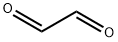
| Definition | ChEBI: Glyoxal is the dialdehyde that is the smallest possible and which consists of ethane having oxo groups on both carbons. It has a role as a pesticide, an agrochemical, an allergen and a plant growth regulator. |
| General Description | Yellow crystals melting at15°C. Hence often encountered as a light yellow liquid with a weak sour odor. Vapor has a green color and burns with a violet flame. |
| Air & Water Reactions | Mixtures with air may explode. Polymerizes quickly on standing, or on contact with a trace of water (possibly a violent reaction), or when dissolved in solvents containing water, [Merck, 502(1968)]. Soluble in water. An aqueous solution contains mono molecular Glyoxal. [Hawley] |
| Reactivity Profile | Glyoxal reacts vigorously with strong oxidizing agents such as nitric acid. Polymerizes rapidly even at low temperature if anhydrous [Noller]. Aqueous solutions are more stable but also polymerize on standing. Reacts with itself in the presence of base to give glyconates. Undergoes addition and condensation reactions that may be exothermic with amines, amides, aldehydes, and hydroxide-containing materials. Mixing in equal molar portions with any of the following substances in a closed container caused the temperature and pressure to increase: chlorosulfonic acid, oleum, ethyleneimine, nitric acid, sodium hydroxide [NFPA 1991]. |
| Hazard | Mixture of vapor and air may explode. Questionable carcinogen. |
| Health Hazard | Glyoxal is a skin and eye irritant; the effectmay be mild to severe. Its vapors are irritatingto the skin and respiratory tract. Anamount of 1.8 mg caused severe irritation inrabbits' eyes. Glyoxal exhibited low toxicityin test subjects. Ingestion may cause somnolenceand gastrointestinal pain. LD50 value, oral (guinea pigs): 760 mg/kg. |
| Health Hazard | Inhalation causes some irritation of nose and,40% solution throat. Contact with liquid,40% solution irritates eyes and causes mild irritation of skin; stains skin yellow. (No information available on symptoms of ingestion.) |
| Fire Hazard | Behavior in Fire: Heat may cause polymerization to a combustible, viscous material. |
| Flammability and Explosibility | Not classified |
| Safety Profile | Low toxicity by SYN: AEROTEX GLYOXAL 40 ingestion and skin contact. A skin irritant. A powerful reducing agent. May explode on contact with air. Polymerizes violently on contact with water. During storage it may spontaneously polymerize and ignite. Reacts violently with chlorosulfonic acid, ethylene imine, HNO3, oleum, NaOH, can cause violent reactions. Can explode during manufacture. When heated to decomposition it emits acrid smoke and irritating fumes. See also ALDEHYDES. |
| Waste Disposal | Glyoxal is mixed with a combustible solventand burned in a chemical incineratorequipped with an afterburner and scrubber. |
| Glyoxal Preparation Products And Raw materials |
| Raw materials | Methanol-->Sodium nitrite-->Aluminum oxide-->Ethylene glycol-->Cupric oxide-->Acetaldehyde-->Quartz tubing, fused, 12.7mm (0.5in) OD for compression type fittings-->strongly acidic type cation exchange resin-->Silver catalyst-->NS-398-->WEAKLY BASIC ANION EXCHANGE RESIN |
| Preparation Products | Imidazole-->Glyoxylic acid-->Fluorescent Brightener 185-->4-Hydroxyphenylacetic acid-->2-Methylimidazole-->6-QUINOXALINECARBOXYLIC ACID-->2-Chloropyrazine-->4-Hydroxy-D-(-)-2-phenylglycine-->6-CHLOROQUINOXALINE-->2,5-Bis(5-tert-butyl-2-benzoxazolyl)thiophene-->1,2-Dimethyl-5-nitroimidazole-->4'-(IMIDAZOL-1-YL)ACETOPHENONE-->4-Hydroxyphenylacetamide-->Allantoin-->Berberine-->Hydroxyethyl Cellulose-->Quinoxaline-->6,7-DINITROQUINOXALINE-->4,5-dihydroxy-1,3-bis(hydroxymethyl)imidazolidin-2-one-->Metronidazole-->CYAZOFAMID-->2-HYDROXYPYRAZINE-->2,3-Pyrazinecarboxylic anhydride-->2-Methoxy-3-sec-butyl pyrazine-->Glyoxalbis(2-hydroxyanil)-->4-Hydroxyphenethyl alcohol-->Amiloride hydrochloride-->2-Amino-4-hydroxy-1H-pteridine-->finishing agent for cotton fabric-->2-Isopropyl-3-methoxypyrazine-->30% sulfaclozine-->2-Methoxy-3-isobutyl pyrazine-->Ethylpyrazine-->2,6-Dichloropyrazine |
Hot Tags: glyoxal, China glyoxal manufacturers, suppliers, factory, Reative Monomers, CAS 42978 66 5, 2 2 Ethoxyethoxy Ethylacrylate, CAS 2156 97 0, Octadecyl Acrylate, Tripropylene Glycol Diacrylate
Previous: 3-Dimethylaminoacrolein
Next: No Information
You Might Also Like
-

Factory Supplier 1-Butylpyridinium Chloride CAS 1124-64-7
-

Factory Sell High Purity CAS 4813-57-4 Octadecyl Acrylate
-

Factory Supply Active monomer CAS 72009-86-0 OPPEA/O-Phenylphenoxyethyl Acrylate
-

Chinese Factory Supplier CAS 492-37-5 Dl-2-Phenylpropionic Acid
-

CAS 4724-47-4 From Chinese Factory N-Octadecylphosphonic Acid
-

Hmpeg 1000 2000 4000 6000 Polyethylene Glycol CAS 25322-68-3
Send Inquiry
