| Description |
Trichlorobenzenes (TCBs) are synthetic chemicals that occur in three different isomeric forms. The three chlorinated cyclic aromatic isomers are 1,2,3-trichlorobenzene (1,2,3-TCB), 1,2,4-trichlorobenzene (1,2,4-TCB), and 1,3,5-trichlorobenzene (1,3,5-TCB). 1,2,4-TCB is one of the 188 chemicals designated as a hazardous air pollutant under the Clean Air Act. |
| Chemical Properties |
1,2,3-Trichlorobenzene and 1,3,5-trichlorobenzene are colorless solids, while 1,2,4-trichlorobenzene is a colorless liquid. Although the three isomers of trichlorobenzenes have the same molecular weight and formula, they each may have different chemical and toxicological properties. One of the isomers (1,2,4-trichlorobenzene) is produced in large quantities and is used as a solvent to dissolve such special materials as oils, waxes, resins, greases, and rubber. It is also frequently used to produce dyes and textiles. The other two isomers, 1,2,3-trichlorobenzene and 1,3,5-trichlorobenzene, are produced in lower quantities and have fewer uses. |
| Uses |
Trichlorobenzenes are primarily used as solvents in chemical manufacturing industries. 1,2,4-Trichlorobenzene is economically the most important isomer. 1,2,4-Trichlorobenzene is used as a solvent in chemical reactions to dissolve oils, waxes, and resins. Furthermore, it is also used as a dye carrier. 1,2,3- Trichlorobenzene is used as an intermediate for pesticides production, pigments, and dyes. 1,3,5-Trichlorobenzene is not marketed commercially and has very limited use as a chemical intermediate. Besides, trichlorobenzenes can also be used as degreasing agents, as septic tanks and drain cleaners, and as an ingredient in wood preservatives and abrasive formulations. Other minor uses include metal work, anticorrosive paint, and corrosion inhibitor in sprays. In the past, mixed isomers of trichlorobenzenes were used to control termites; however, their use has been discontinued. |
| Uses |
Detoxification by catalytic hydrotreatment of 1,2,3-Trichlorobenzene is used for the disposal of hazardous organic waste liquids. As constituent of trichlorobenzene mixt used for termite control. As transformer fluid, dye carrier & solvent. Solvent for high melting products, Coolant in electrical installations and glass tempering. In polyester dyeing, lubricants, Heat transfer medium. As chemical intermediate for 2,3-dichlorophenol. |
| Definition |
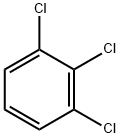
ChEBI: 1,2,3-trichlorobenzene is a trichlorobenzene carrying chloro substituents at positions 1, 2 and 3. |
| General Description |
A white solid with a sharp chlorobenzene odor. Insoluble in water and denser than water. Hence sinks in water. Melting point 63-64°C (145-147°F). |
| Air & Water Reactions |
Insoluble in water. |
| Reactivity Profile |
1,2,3-Trichlorobenzene can react with oxidizing agents. . May emit toxic hydrogen chloride and phosgene gases in fire. |
| Health Hazard |
Inhalation may cause irritation of respiratory tract. Irritating to the eyes. May redden skin on contact. Ingestion may cause liver damage. |
| Environmental fate |
Biological. Under aerobic conditions, soil microbes are capable of degrading 1,2,3- trichlorobenzene to 1,2- and 1,3-dichlorobenzene and carbon dioxide (Kobayashi and Rittman, 1982). A mixed culture of soil bacteria or a Pseudomonas sp. transformed 1,2,3-trichlorobenzene to 2,3,4-, 3,4,5-, and 2,3,6-trichlorophenol (Ballschiter and Scholz, 1980).
In an enrichment culture derived from a contaminated site in Bayou d'Inde, LA, 1,2,3- trichlorobenzene underwent reductive dechlorination to 1,2- and 1,3-dichlorobenzene at relative molar yields of 1 and 99%, respectively. The maximum dechlorination rate, based on the recommended Michaelis-Menten model, was 60 nM/d (Pavlostathis and Prytula, 2000).
Photolytic. The sunlight irradiation of 1,2,3-trichlorobenzene (20 g) in a 100-mL borosilicate glass-stoppered Erlenmeyer flask for 56 d yielded 32 ppm pentachlorobiphenyl (Uyeta et al., 1976).
Chemical/Physical. At 70.0 °C and pH values of 3.07, 7.13, and 9.80, the hydrolysis half-lives were calculated to be 19.2, 15.0, and 34.4 d, respectively (Ellington et al., 1986). Emits toxic chloride fumes when heated to decomposition. |
| Purification Methods |
Crystallise it from EtOH. [Beilstein 5 IV 664.] |
| Toxicity evaluation |
The liver is themain target of trichlorobenzenes irrespective of the route of exposure. The mechanisms of liver toxicity induced by these chemicals have not been illustrated. It might involve intermediate arene oxides formed during initial transformation to trichlorophenols. In addition, exposure to 1,2,4-TCB induced porphyria in rats by inducing δ-aminolevulinic acid (ALA) synthetase, a rate-limiting enzyme in the biosynthesis of heme, and also heme oxygenase, a ratelimiting enzyme in the degradation of heme synthetase, and therefore increasing heme production. |




![2-methyl-1,4-diazabicyclo[2.2.2]octane](/uploads/41226/small/2-methyl-1-4-diazabicyclo-2-2-2-octane102ce.gif?size=336x0)


