



Product Introduction
| 2-Phenoxyethanol Basic information |
| Odor |
| Product Name: | 2-Phenoxyethanol |
| Synonyms: | Ethylene Glycol Monophenyl Ether Phenyl Cellosolve Phenyl Glycol;ETHYLENE GLYCOL MONOPHENYL ETHER FOR SYN;(2-Hydroxyethoxy)benzene;PhG;Protectol PE;ACETONITRILE ACS GRADE;beta-Phenoxyethanol;beta-phenoxyethanol[qr] |
| CAS: | 122-99-6 |
| MF: | C8H10O2 |
| MW: | 138.16 |
| EINECS: | 204-589-7 |
| Product Categories: | Imidazoles ,Heterocyclic Acids;Organic Building Blocks;Benzhydrols, Benzyl & Special Alcohols;Ethylene Glycols & Monofunctional Ethylene Glycols;Oxygen Compounds;Polymer Science;Monofunctional Ethylene Glycols;Hydrophobic Polymers;Propylene Glycol Oligomers;Alcohols;Building Blocks;C7 to C8;Chemical Synthesis;Ethers;Materials Science;bc0001;122-99-6 |
| Mol File: | 122-99-6.mol |
 |
|
| 2-Phenoxyethanol Chemical Properties |
| Melting point | 11-13 °C (lit.) |
| Boiling point | 247 °C (lit.) |
| density | 1.102 g/mL at 25 °C (lit.) |
| vapor density | 4.8 (vs air) |
| vapor pressure | 0.01 mm Hg ( 20 °C) |
| refractive index | n20/D 1.539 |
| FEMA | 4620 | 2-PHENOXYETHANOL |
| Fp | >230 °F |
| storage temp. | Store below +30°C. |
| solubility | soluble, clear, colorless to very faintly yellow |
| form | Liquid |
| pka | 14.36±0.10(Predicted) |
| Specific Gravity | 1.109 (20/4℃) |
| color | Clear colorless |
| PH | 7 (10g/l, H2O, 23℃) |
| Odor | Faint aromatic odor |
| PH Range | 7 at 10 g/l at 23 °C |
| Odor Type | floral |
| explosive limit | 1.4-9.0%(V) |
| Water Solubility | 30 g/L (20 ºC) |
| Merck | 14,7257 |
| BRN | 1364011 |
| InChIKey | QCDWFXQBSFUVSP-UHFFFAOYSA-N |
| LogP | 1.2 at 23℃ |
| CAS DataBase Reference | 122-99-6(CAS DataBase Reference) |
| NIST Chemistry Reference | 2-Phenoxyethanol(122-99-6) |
| EPA Substance Registry System | Ethylene glycol monophenyl ether (122-99-6) |
| Safety Information |
| Hazard Codes | Xn,Xi |
| Risk Statements | 22-36-R36-R22 |
| Safety Statements | 26-S26 |
| WGK Germany | 1 |
| RTECS | KM0350000 |
| Autoignition Temperature | 535 °C DIN 51794 |
| Hazard Note | Irritant |
| TSCA | Yes |
| HS Code | 29094990 |
| Hazardous Substances Data | 122-99-6(Hazardous Substances Data) |
| Toxicity | LD50 orally in Rabbit: 1850 mg/kg LD50 dermal Rabbit > 2000 mg/kg |
| MSDS Information |
| Provider | Language |
|---|---|
| Ethylene glycol monophenyl ether | English |
| SigmaAldrich | English |
| ACROS | English |
| ALFA | English |
| 2-Phenoxyethanol Usage And Synthesis |
| Odor | Mild and weak, but sweet and pleasantly floral odor of excellent tenacity. |
| Description | Phenoxyethanol is an organic chemical compound, a glycol ether often used in dermatological products such as skin creams and sunscreen. It is a colorless oily liquid. It is a bactericide (usually used in conjunction with quaternary ammonium compounds). Phenoxyethanol is used in many applications such as cosmetics, vaccines and pharmaceuticals as a preservative. |
| Chemical Properties | clear colorless liquid |
| Chemical Properties | Phenoxyethanol is a colorless, slightly viscous liquid with a faint pleasant odor and burning taste. |
| Characteristics | Phenoxyethanol is a tried-and-tested preservative, which is welltolerated by the skin and has a low allergy risk. It can be used over a wide pH range. This means that other preservatives can lose their effectiveness if the product is not within the right pH range. It does not smell unpleasant or change the color of the product, which can be the case when using natural antimicrobial substances. |
| Uses | phenoxyethanol is a broad-range preservative with fungicidal, bactericidal, insecticidal, and germicidal properties. It has a relatively low sensitizing factor in leave-on cosmetics. Phenoxyethanol can be used in concentrations of 0.5 to 2.0 percent, and in combination with other preservatives such as sorbic acid or parabens. In addition, it is used as a solvent for aftershaves, face and hair lotions, shampoos, and skin creams of all types. It can be obtained from phenol. |
| Uses | Ethylene glycol phenyl ether at a 1.0% level acts as a preservative in personal care products. |
| Uses | Phenoxyethanol is a preservative used in consumer and health care products, including vaccines, pen inks, ear drops, shampoos, skin cleansers, moisturizers, sun care products, and topical medicaments. The preservative Euxyl-K 400 also contains 2-phenoxyethanol, in combination with methyldibromoglutaronitrile. Phenoxyethanol is commonly used in cosmetics for its antibacterial and antifungal properties. It is increasingly being used in vaccines as a substitute for thiomersal and is also a component of pen inks and, more rarely, ear drops.Reactions to phenoxyethanol have rarely been reported. Three cases of CoU induced by phenoxyethanol in cosmetics have been reported.2-Phenoxyethanol is used as a single agent and in combination with other preservatives such as 1,2-dibromo-2,4-dicyanobutane (Euxyl K 400) and parabens, or in conjunction with quaternary ammonium compounds.The possibility of immunological IgE-mediated reaction could not be confirmed because specific IgE against 2-phenoxyethanol was negative. |
| Uses | Antimicrobial preservative; also used topically in treatment of bacterial infections. |
| Production Methods | Phenoxyethanol is prepared by treating phenol with ethylene oxide in an alkaline medium. |
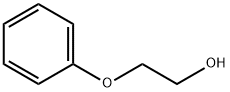
| Definition | ChEBI: 2-phenoxyethanol is an aromatic ether that is phenol substituted on oxygen by a 2-hydroxyethyl group. It has a role as an antiinfective agent and a central nervous system depressant. It is a primary alcohol, a glycol ether and an aromatic ether. It is functionally related to a phenol. |
| Synthesis Reference(s) | The Journal of Organic Chemistry, 40, p. 1356, 1975 DOI: 10.1021/jo00897a043 |
| General Description | Colorless liquid with a pleasant odor. Density 1.02 g / cm3. An irritant. |
| Air & Water Reactions | Oxidizes in air to form unstable peroxides that may explode spontaneously [Bretherick, 1979 p.151-154, 164]. Water soluble. |
| Reactivity Profile | 2-Phenoxyethanol may react violently with strong oxidizing agents. May generate flammable and/or toxic gases with alkali metals, nitrides, and other strong reducing agents. May initiate the polymerization of isocyanates and epoxides. |
| Health Hazard | May cause moderate eye irritation and moderate corneal injury. Excessive exposure may cause skin irritation and hemolysis. |
| Fire Hazard | 2-Phenoxyethanol is combustible. |
| Flammability and Explosibility | Not classified |
| Pharmaceutical Applications | Phenoxyethanol is an antimicrobial preservative used in cosmetics and topical pharmaceutical formulations at a concentration of 0.5–1.0%; it may also be used as a preservative and antimicrobial agent for vaccines.Therapeutically, a 2.2% solution or 2.0% cream has been used as a disinfectant for superficial wounds, burns, and minor infections of the skin and mucous membranes. Phenoxyethanol has a narrow spectrum of activity and is thus frequently used in combination with other preservatives, |
| Industrial uses | 2-Phenoxyethanol is used as a preservative in cosmetic formulations at a maximum concentration of 1.0%. 2-Phenoxyethanol is a broad spectrum preservative which has excellent activity against a wide range of Gram negative and Gram positive bacteria, yeast and mould. It is also used as a solvent and, because of its properties as a solvent, it is used in many blends and mixtures with other preservatives. 2-Phenoxyethanol is not registered as a food additive in the EU. Scognamiglio et al. (ref. 105) reported that 2-phenoxyethanol is a fragrance ingredient used in many fragrance mixtures (see discussion). An ester of 2-Phenoxyethanol, 2-Phenoxyethyl isobutyrate and 2-Phenoxyacetic acid, the main metabolite of 2-Phenoxyethanol, were mentioned in a WHO publication where 43 flavouring agents in food were evaluated (WHO 2003, AR4), however at intakes assessed to be very low in Europe (around 1 µg/kg bw/day). |
| Contact allergens | Phenoxyethanol is an aromatic ether-alcohol used mainly as a preservative, mostly with methyldibromoglutaronitrile (in Euxyl? K 400) or with parabens. Sensitization to this molecule is very rare. |
| Side effects | 2-phenoxyethanol is a colorless or straw-colored oily liquid with slight solubility in water but soluble in ethanol and is used as an immersion anesthetic. This agent has bactericidal and fungicidal properties and has been used as a topical anesthetic. This agent can provide deep stages of anesthesia and is relatively inexpensive. Nevertheless, it has no other significant advantages over other drugs. Using 2-phenoxyethanol can elicit several side effects, such as decreased respiratory and heart rate, reduced blood pressure and blood oxygenation, alterations of blood parameters, and elevated plasma levels of adrenaline, glucose, and cortisol, as shown in bighead carp. In addition, sustained and prolonged exposure to 2-phenoxyethanol can cause neuropsychological syndrome in handlers[1]. |
| References | [1] Almut Khler, Karin Finger-Baier, Luis Antunes. "Chapter 16 - Anesthesia, restraint and analgesia in laboratory fishes." Anesthesia and Analgesia in Laboratory Animals (Third Edition) (2023): 393-409. |
| Safety Profile | Moderately toxic by ingestion and skin contact. A skin and severe eye irritant. Mutation data reported. Some glycol ethers have dangerous human reproductive effects. Combustible when exposed to heat or flame; can react vigorously with oxidizing materials. When heated to decomposition it emits acrid smoke and irritating fumes. To fight fEe, use CO2, dry chemical. Used as a solvent for ester-type resins. See also GLYCOL ETHERS. |
| Safety | Phenoxyethanol produces a local anesthetic effect on the lips, tongue, and other mucous membranes. The pure material is a moderate irritant to the skin and eyes. In animal studies, a 10% v/v solution was not irritant to rabbit skin and a 2% v/v solution was not irritant to the rabbit eye.Long-term exposure to phenoxyethanol may result in CNS toxic effects similar to other organic solvents.Safety issues related to preservatives used in vaccines, including 2-phenoxyethanol have been reviewed.Contact urticaria has been reported upon exposure to 2-phenoxyethanol-containing cosmetics. The US FDA has recommended avoiding at least one topical product containing phenoxyethanol due to concerns over inadvertant exposure to nursing infants. LD50 (rabbit, skin): 5 g/kg LD50 (rat, oral): 1.26 g/kg |
| storage | Aqueous phenoxyethanol solutions are stable and may be sterilized by autoclaving. The bulk material is also stable and should be stored in a well-closed container in a cool, dry place. |
| Incompatibilities | The antimicrobial activity of phenoxyethanol may be reduced by interaction with nonionic surfactants and possibly by absorption by polyvinyl chloride.The antimicrobial activity of phenoxyethanol against Pseudomonas aeruginosa may be reduced in the presence of cellulose derivatives (methylcellulose, sodium carboxymethylcellulose, and hypromellose (hydroxypropylmethylcellulose)). |
| Regulatory Status | Included in the FDA Inactive Ingredients Database (topical preparations). Included in nonparenteral medicines licensed in the UK. Included in the Canadian List of Acceptable Non-medicinal Ingredients. Under European regulations for cosmetics (76/768/EEC), the maximum authorized concentration (MAC) of 2-phenoxyethanol is 1.0%. |
| 2-Phenoxyethanol Preparation Products And Raw materials |
| Raw materials | ETHYLENE OXIDE-->2-Fluoroethanol-->Sodium benzenolate-->Ethyl phenoxyacetate-->2-Iodoethanol-->2-Bromoethanol-->Phenol-->Methyl phenoxyacetate-->Ethylene carbonate-->2-Chloroethanol-->Phenoxyacetic acid |
| Preparation Products | Pyriproxyfen-->impregnanting agent for leather-->bis(2-phenoxyethyl) peroxydicarbonate-->Phenoxyethyl isobutyrate-->CORTEX ALDEHYDE 50 BENZYL ALCOHOL-->1,4-Benzodioxan-->2-(2,4-DICHLOROPHENOXY)ETHANOL-->2-(4-aminophenoxy)ethanol |
Hot Tags: 2-phenoxyethanol, China 2-phenoxyethanol manufacturers, suppliers, factory, CAS 4813 57 4, 1 6 Hexamethylene Diacrylate, CAS 13048 33 4, CAS 9004 74 4, Dipropylene Glycol Diacrylate, Propoxylated Trimethylolpropane Triacrylate
Previous: 2-PROPOXYETHANOL
You Might Also Like




Send Inquiry
