Building Blocks;C9;Ketones;Carbonyl Compounds;Chemical Synthesis;Organic Building Blocks;Aromatics, Impurities, Intermediates;API
Mol File:
936-59-4.mol
3-Chloropropiophenone Chemical Properties
Melting point
48-50 °C(lit.)
Boiling point
113-115 °C4 mm Hg(lit.)
density
1.1115 (rough estimate)
refractive index
1.5350 (estimate)
Fp
>230 °F
storage temp.
Inert atmosphere,Room Temperature
solubility
Chloroform (Slightly), Methanol (Slightly)
form
Solid
color
Off-White to Pale Yellow
Water Solubility
Insoluble
BRN
2043580
Stability:
Stable. Incompatible with strong bases, strong oxidizing agents.
CAS DataBase Reference
936-59-4(CAS DataBase Reference)
NIST Chemistry Reference
1-Propanone, 3-chloro-1-phenyl-(936-59-4)
EPA Substance Registry System
1-Propanone, 3-chloro-1-phenyl- (936-59-4)
Safety Information
Hazard Codes
Xi
Risk Statements
36/37/38
Safety Statements
37/39-26-24/25
WGK Germany
3
TSCA
Yes
HS Code
29147000
MSDS Information
Provider
Language
3-Chloro-1-phenyl-1-propanone
English
SigmaAldrich
English
ACROS
English
ALFA
English
3-Chloropropiophenone Usage And Synthesis
Description
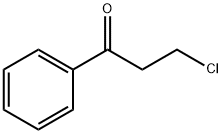
3-Chloropropiophenone is a chiral compound that is used as an antidepressant drug. It was first synthesized in the 1950s and has been studied extensively for its pharmacological effects. It is a racemic mixture of two enantiomers, one of which is active and the other inactive. The active enantiomer binds to serotonin receptors and inhibits the reuptake of serotonin, which leads to an increase in serotonin levels. The inactive enantiomer does not bind to serotonin receptors and does not inhibit the reuptake of serotonin. 3-Chloropropiophenone has been shown to be effective when administered at an optimum concentration of 5 milligrams per kilogram body weight.
Chemical Properties
faintly yellow to tan crystalline powder
Uses
3-Chloropropiophenone is an Impurity of Fluoxetine (F597100).
Uses
3-Chloropropiophenone was used in the asymmetric reduction of (S)-3-chloro-1-phenylpropanol using preheated Candida utilis cells immobilized in calcium alginate gel beads. It was also used in the synthesis of (R)-3-chloro-1-phenyl-1-propanol via asymmetric reduction using in-situ generated oxazaborolidine catalyst derived from (S)-α,α-diphenylprolinol. It is a precursor of phenyl vinyl ketone.
Synthesis
Adding 3' -chlorobenzene acetone and levorotatory prolinol into 95% ethanol and stirring; cooling after the reaction liquid is wholly dissolved; adding potassium borohydride into the reaction solution in batches, and preserving heat after adding; heating the reaction solution for reflux reaction, and concentrating the reaction solution under reduced pressure; adding n-hexane into the reaction solution, heating, and adding active carbon for heat preservation and decoloration; filtering the reaction solution, leaching a filter cake by using normal hexane, and collecting filtrate; crystallizing and filtering the filtrate, leaching the filter cake once with n-hexane, and drying in vacuum to obtain 3-Chloropropiophenone.
3-Chloropropiophenone Preparation Products And Raw materials