| Chemical Properties |
colourless liquid with a strong smell |
| Chemical Properties |
2-Ethyl-3-propyl acrolein is a colorless or yellowish liquid with a sharp, powerful, irritating odor |
| Uses |
Insecticide, organic synthesis (intermediate), warning agents, and leak detectors. |
| Definition |
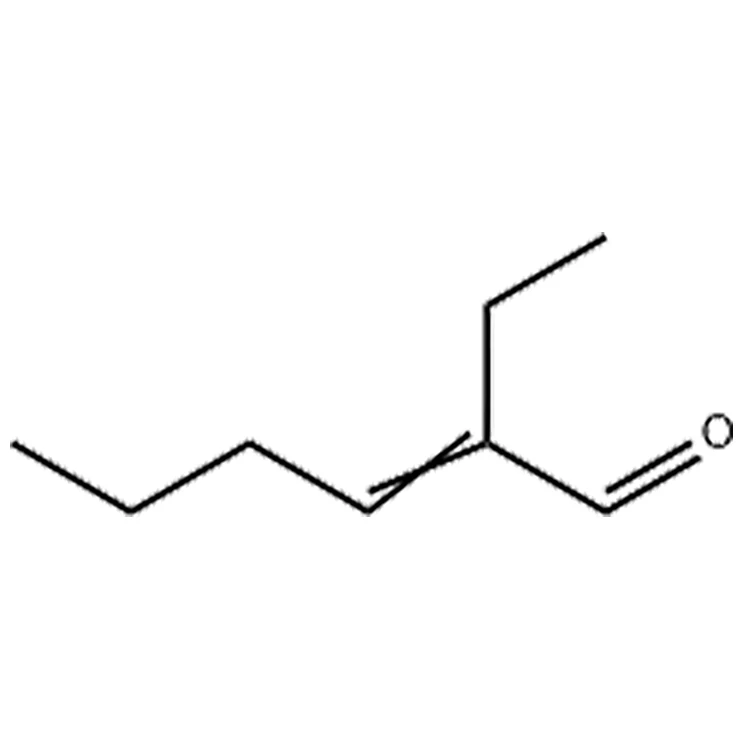
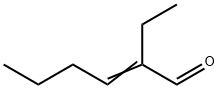
ChEBI: 2-ethyl-2-hexenal is a monounsaturated fatty aldehyde that is hex-2-enal substituted by an ethyl group at position 2. It has a role as a plant metabolite, a human metabolite and a flavouring agent. It is a monounsaturated fatty aldehyde and an enal. |
| Synthesis Reference(s) |
Tetrahedron Letters, 15, p. 959, 1974 DOI: 10.1016/S0040-4039(01)82378-9 |
| General Description |
Yellow liquid. Floats on water. |
| Air & Water Reactions |
Insoluble in water. |
| Reactivity Profile |
2-ETHYL-2-HEXENAL is an aldehyde. Aldehydes are frequently involved in self-condensation or polymerization reactions. These reactions are exothermic; they are often catalyzed by acid. Aldehydes are readily oxidized to give carboxylic acids. Flammable and/or toxic gases are generated by the combination of aldehydes with azo, diazo compounds, dithiocarbamates, nitrides, and strong reducing agents. Aldehydes can react with air to give first peroxo acids, and ultimately carboxylic acids. These autoxidation reactions are activated by light, catalyzed by salts of transition metals, and are autocatalytic (catalyzed by the products of the reaction). The addition of stabilizers (antioxidants) to shipments of aldehydes retards autoxidation. 2-ETHYL-2-HEXENAL will react with oxidants. |
| Hazard |
Toxic by inhalation and ingestion; strong irritant. |
| Health Hazard |
Vapor is irritating. Contact produces skin and eye irritation. |
| Flammability and Explosibility |
Not classified |
| Potential Exposure |
Those workers involved in organic synthesis operations and use of this flammable and toxic aldehyde warning agent.v |
| Shipping |
UN1988 Aldehydes, flammable, toxic, n.o.s., Hazard Class: 3; Labels: 3-Flammable liquid, 6.1-Poisonous materials, Technical Name Required |
| Incompatibilities |
Aldehydes are frequently involved in self-condensation or polymerization reactions. These reactions are exothermic; they are often catalyzed by acid. Aldehydes are readily oxidized to give carboxylic acids. Flammable and/or toxic gases are generated by the combination of aldehydes with azo, diazo compounds, dithiocarbamates, nitrides, and strong reducing agents. Aldehydes can react with air to give first peroxo acids, and ultimately carboxylic acids. These autoxidation reactions are activated by light, catalyzed by salts of transition metals, and are autocatalytic (catalyzed by the products of the reaction). The addition of stabilizers (antioxidants) to shipments of aldehydes retards autoxidation. Incompatible with oxidizers (chlorates, nitrates, peroxides, permanganates, perchlorates, chlorine, bromine, fluorine, etc.); contact may cause fires or explosions. Keep away from alkaline materials, strong bases, strong acids, oxoacids, epoxides, caustics, ammonia, and amines |
| Waste Disposal |
Incineration, or dissolve in flammable solvent and spray into incinerator containing afterburner |