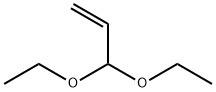
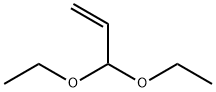
| Description |
3,3-Diethoxypropene is a colorless flammableliquid; Molecular weight=130.21; Boiling point=123.5℃;Flash point=4.4℃. Hazard Identification (based on HMISRating System scale: 0-4): Health 1, Flammability 3,Reactivity 1. Water solubility=not determined. |
| Chemical Properties |
clear colorless liquid |
| Uses |
Acrolein diethyl acetal is a reagent used for the synthesis of a variety of compounds, including cinnamaldehydes. |
| Uses |
Acrolein diethyl acetal is widely used to carry out chemoselective Heck arylation to synthesize either 3-arylpropanoate esters or cinnamaldehyde derivatives.
It can also be used as one of the precursors to synthesize natural products like (?)-(Z)-Deoxypukalide, (?)-Laulimalide, botryodiplodin, neolaulimalide and isolaulimalide. |
| General Description |
A colorless liquid with an agreeable odor. Very volatile. Flash point 70°F. Less dense than water. Vapors heavier than air. Used as a solvent and to make cosmetics. |
| Air & Water Reactions |
Highly flammable. Soluble in water. Likely to slowly form peroxidized product when exposed to air. The formed peroxide is likely to be unstable. |
| Reactivity Profile |
Ethers, such as DIETHOXYPROPENE, can act as bases. They form salts with strong acids and addition complexes with Lewis acids. The complex between diethyl ether and boron trifluoride is an example. Ethers may react violently with strong oxidizing agents. In other reactions, which typically involve the breaking of the carbon-oxygen bond, ethers are relatively inert. |
| Health Hazard |
Inhalation or contact with material may irritate or burn skin and eyes. Fire may produce irritating, corrosive and/or toxic gases. Vapors may cause dizziness or suffocation. Runoff from fire control may cause pollution. |
| Fire Hazard |
HIGHLY FLAMMABLE: Will be easily ignited by heat, sparks or flames. Vapors may form explosive mixtures with air. Vapors may travel to source of ignition and flash back. Most vapors are heavier than air. They will spread along ground and collect in low or confined areas (sewers, basements, tanks). Vapor explosion hazard indoors, outdoors or in sewers. Runoff to sewer may create fire or explosion hazard. Containers may explode when heated. Many liquids are lighter than water. |
| Safety Profile |
Mutation data reported. A flammable liquid. A dangerous fire hazard when exposed to heat, flame, or oxiduers. When heated to decomposition it emits acrid smoke and fumes. |
| Potential Exposure |
Used by technically qualified individuals only; in organic synthesis. US EPA under TSCArestricts use of this chemical to R&D only. |
| First aid |
If this chemical gets into the eyes, remove anycontact lenses at once and irrigate immediately for at least15 min, occasionally lifting upper and lower lids. Seek medical attention immediately. If this chemical contacts theskin, remove contaminated clothing and wash immediatelywith soap and water. Seek medical attention immediately. Ifthis chemical has been inhaled, remove from exposure,begin rescue breathing (using universal precautions, including resuscitation mask) if breathing has stopped and CPR ifheart action has stopped. Transfer promptly to a medicalfacility. When this chemical has been swallowed, get medical attention. Give large quantities of water and inducevomiting. Do not make an unconscious person vomit. |
| storage |
Color Code-Red: Flammability Hazard: Store in aflammable liquid storage area or approved cabinet away fromignition sources and corrosive and reactive materials. Prior toworking with this chemical you should be trained on itsproper handling and storage. Store in tightly closed containers in a cool, well-ventilated area away from acids and strongoxidizers. Sources of ignition, such as smoking and openflames, are prohibited where diethoxypropene is handled,used, or stored. Metal containers involving the transfer of 5gallons or more of diethoxypropene should be grounded andbonded. Drums must be equipped with self-closing valves,pressure vacuum bungs, and flame arresters. Use only nonsparking tools and equipment, especially when opening andclosing containers of diethoxypropene. Wherever diethoxypropene is used, handled, manufactured, or stored, use explosion-proof electrical equipment and fittings. |
| Shipping |
3,3-Diethoxypropene must bear a"FLAMMABLE LIQUID" label. It falls in Hazard Class 3and Packing Group II. |
| Purification Methods |
Add Na2CO3 (ca 3.5%) and distil it using an efficient column, or better use a spinning band column. [Witzemann et al. Org Synth Coll Vol II 17 1943, Beilstein 1 H 727, 1 I 378, 1 III 2960, 1 IV 3437.] |
| Incompatibilities |
Forms explosive mixture with air.Contact with acids and strong oxidizers may cause fire andexplosion hazard. |