| Chemical Properties |
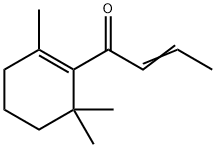
Beta-Damascone is a colorless to pale yellow liquid with a very powerful floral, complex fruity note, reminiscent of plum, rose, and blackcurrant. ??-Damascone is found as a volatile constituent of many natural materials, for example, in rose oils and extracts.
One synthetic route to the damascones starts with an appropriate cyclogeranic acid derivative (halide, ester, etc.). This is reacted with an allyl magnesium halide to give 2,6,6-trimethylcyclohexenyl diallyl carbinol, which on pyrolysis yields the desired l-(2,6,6-trimethylcyclohexenyl)-3-buten-l-one. Damascone is obtained by rearrangement of the double bond in the side chain.
The ??- and ??-damascones are used in perfume compositions, especially rose perfumes, and in flavor compositions, to which they impart naturalness and body. |
| Occurrence |
In Burley tobacco oil; in volatile fractions from leaves of Carphephorus corymbosus and C. paniculatus. Reported found in bilberry, butter, milk, caviar, chicken fat, cooked beef and mutton, cured pork, pork and beef fat, roasted filberts and peanuts, pecans, potato chips, soybean, coriander leaf and seed and kiwifruit. |
| Preparation |
Various methods: recently from ionone izoxazoles, also from 7,8-dehydro-β-ionole. |
| Aroma threshold values |
Detection: 8.6 to 41 ppb |
| Taste threshold values |
Taste characteristics at 30 ppm: green, woody, minty with a herbal floral nuance. |





![1-(4-Chlorophenyl)-3-[(2-nitrophenyl)methoxy]-1H-pyrazole](/uploads/41226/small/1-4-chlorophenyl-3-2-nitrophenyl-methoxy-1he4202.jpg?size=336x0)


