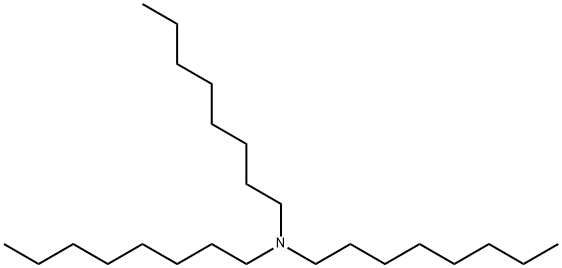
Tri-N-caprylylamine;Tri-N-Octylamine,>96%;Tri-n-octylamine [Reagent for Ion-Pair Chromatography];Trioctylamine: (n,n-Dioctyl-1-octanamine);Trioctylamin;N,N-Dioctyloctan-1-amine;Tri-Normal-octylamine, 98%;Tri-n-octylamine,98%
CAS:
1116-76-3
MF:
C24H51N
MW:
353.67
EINECS:
214-242-1
Product Categories:
Basic organic chemicals;solvent;C17 to C40+;Building Blocks;Chemical Synthesis;Isoquinolines ,Quinolines ,Quinaldines;Organics;Amines;C11 to C38;Nitrogen Compounds;Nitrogen Compounds;Organic Building Blocks
Mol File:
1116-76-3.mol
Tri-n-octylamine Chemical Properties
Melting point
34 °C
Boiling point
164-168 °C/0.7 mmHg (lit.) 365-367 °C (lit.)
density
0.809 g/mL at 25 °C (lit.)
vapor pressure
<0.01 hPa (20 °C)
refractive index
n20/D 1.449(lit.)
Fp
>230 °F
storage temp.
Store below +30°C.
solubility
chloroform: 0.1 g/mL, clear, colorless
form
Low Melting Crystalline Mass
pka
10.08±0.50(Predicted)
Specific Gravity
0.811 (20/4℃)
color
White to off-white
Water Solubility
Miscible with chloroform. Immiscible with water.
Sensitive
Air Sensitive
BRN
1210618
InChIKey
XTAZYLNFDRKIHJ-UHFFFAOYSA-N
CAS DataBase Reference
1116-76-3(CAS DataBase Reference)
NIST Chemistry Reference
1-Octanamine, N,N-dioctyl-(1116-76-3)
EPA Substance Registry System
Trioctylamine (1116-76-3)
Safety Information
Hazard Codes
Xi,N
Risk Statements
36/37/38-51/53
Safety Statements
26-61-36/37/39-29
RIDADR
UN3082
WGK Germany
2
RTECS
RG8225000
F
10-23
Autoignition Temperature
315 °C
TSCA
Yes
HazardClass
9
PackingGroup
III
HS Code
29211980
Hazardous Substances Data
1116-76-3(Hazardous Substances Data)
Toxicity
LD50 intraperitoneal in rat: 1gm/kg
MSDS Information
Provider
Language
Tri-n-octylamine
English
ACROS
English
SigmaAldrich
English
ALFA
English
Tri-n-octylamine Usage And Synthesis
Chemical Properties
Tri-n-octylamine is clear colorless liquid
Uses
Tri-n-octylamine is used as an extractant for organic acids and precious metals.
Uses
Tri-n-octylamine is used as an extractant for organic acids like trichloroacetic acid, succinic acid, acetic acid and precious metals. It is also used as a solvent and an intermediate in the manufacture of pharmaceuticals. Further, it is employed in the preparation of quaternary ammonium compounds, agrochemicals, surfactants, lubricant additives, corrosion inhibitors, vulcanization accelerators and dyes.
Uses
Trioctylamine is used as an extractant for organic acids (such as TCA, succinic acid, and acetic acid), and precious metals.
Purification Methods
It is converted to the amine hydrochloride etherate which is recrystallised four times from diethyl ether at -30o (see below). Neutralisation of this salt regenerates the free amine which distil under high vacuum. [Wilson & Wogman J Phys Chem 66 1552 1962.] Distil the amine at 1-2mm pressure. [Beilstein 4 H 196, 4 III 382, 4 IV 754.]
Tri-n-octylamine Preparation Products And Raw materials